🎓 NMIMS Solved Assignment & Project 2026 – Complete Guide for NMIMS Distance Learning Students:
NMIMS Solved Assignment & Project 2026 | NMIMS Distance Learning MBA Assignment & Project for all distance students:
You can obtain the original NMIMS Solved Assignments for 2026. One-of-a-kind, well written MBA assignment assistance for NMIMS Global (NGASCE) with a guaranty of high scores.
NMIMS Solved Assignments: Top-Notch Academic Assistance:
NMIMS Solved Assignments are professionally written academic solutions that assist NMIMS University students in finishing their assignments accurately and on time. These are just sample assignments that follow the NMIMS requirements, question forms, and evaluation criteria. Each solution seeks to exhibit critical thought, conceptual lucidity, and the useful implementation of management principles.
The Excellent NMIMS Solved Assignments are entirely free of plagiarism and follow the most recent syllabus. These consist of thoughtful responses, case-based reasoning, practical examples, and appropriate academic organization. Each response will be unique, accurate, and comprehensible, and the content conforms with NMIMS requirements.
NMIMS solved assignments encompass all major programs, including MBA, BBA, and PGDM, as well as specialty management courses including marketing management, financial accounting, human resource management, operations, business analytics, and strategic management. Thru these assignments, students can improve their academic performance, develop a deeper comprehension of difficult subjects, and increase their confidence in their subject area competence.
In conclusion, the NMIMS solved assignment is a reliable academic resource that helps students grasp the material quickly while maintaining originality and ethical academic conduct.
NMIMS Completed Tasks & Original Approach:
Completely original and free of plagiarism
prepared in accordance with NMIMS regulations
Subject-specific specialist solutions
Revised curriculum and case-study methodology
Ideal for learning and reference
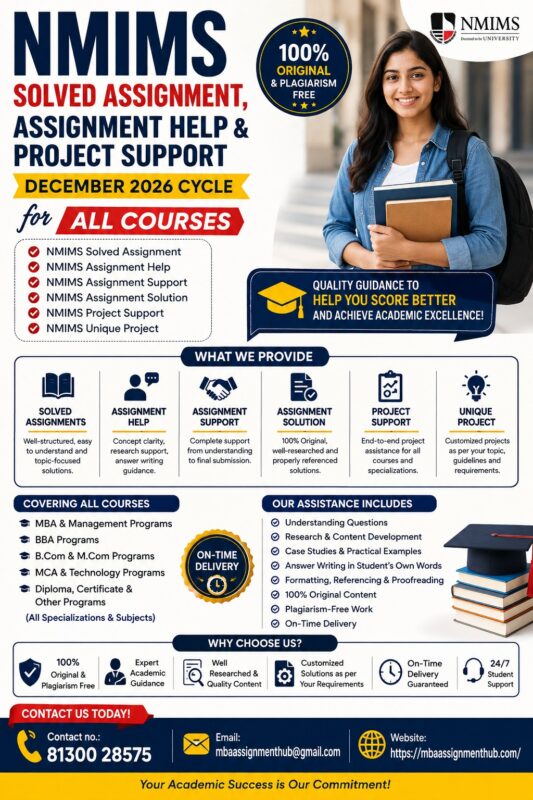
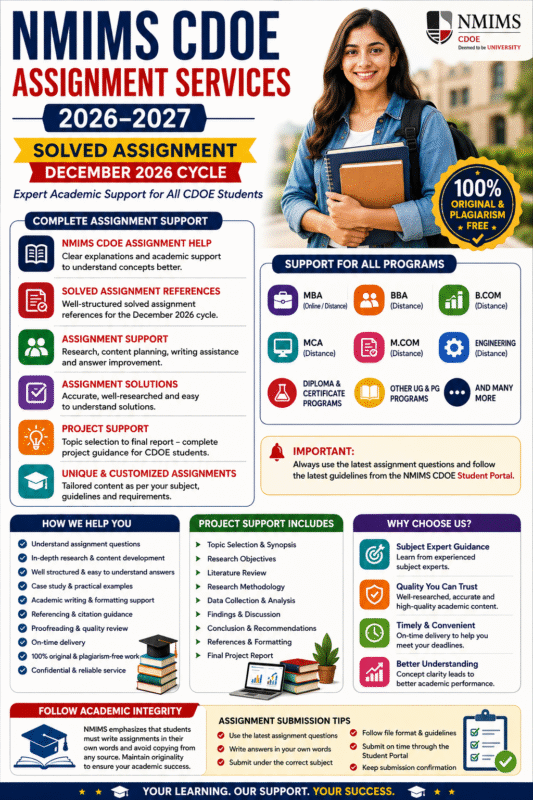
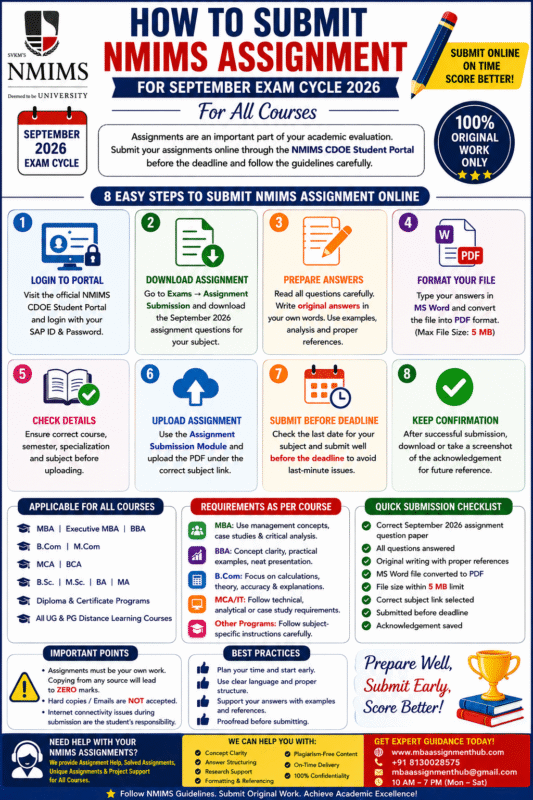
For all courses, MBAassignmenthub.com provides NMIMS solved assignments, NMIMS assignment answers, NMIMS unique assignments, NMIMS MBA assignment solutions, NMIMS Sept 2026 assignments, NMIMS global assignment assistance, and NMIMS project reports.
🧾 What is the NMIMS Solved Assignment?
NMIMS Solved Assignments are pre-prepared, thoroughly researched, and properly organized assignments that meet the official requirements of NMIMS Global Access School for Continuing Education (NGASCE).
Before turning in their final assignments, students enrolled in MBA, BBA, BCom, or other management courses at Narsee Monjee Institute of Management Studies (NMIMS) can use these completed assignments to understand the question structure, writing style, and expected response format.
Subject matter specialists create all NMIMS solved assignments, guaranteeing their quality, applicability, and current compliance with university requirements.
🎯 Why Do Students Need Assignments Solved by NMIMS?
Many NMIMS remote learning students and working professionals deal with issues like:
Time constraints brought on either personal or professional obligations
Inability to comprehend academic ideas
Uncertainty over word restrictions and NMIMS formatting
Fear of receiving poor grades or plagiarism
This is where NMIMS Solved Assignments come in handy, providing ready-to-use, exceptional, and original work that guaranties top grades while saving time.
These tasks are written in accordance with the December 2025 exam pattern and the most recent curriculum.
NMIMS Solved Assignments 2026 Features:
✅ Plagiarism-Free Content: All assignments are produced entirely from scratch, guaranteeing complete originality.
✅ University Format Compliance: Adheres to the word limit, reference style, and NMIMS NGASCE formatting.
✅ Expert-Written Responses: Written by scholars with Ph.D. and MBA degrees.
✅ Customized Topics: Assignments made specifically for each student’s area of expertise, including business analytics, operations, marketing, finance, and human resources.
✅ Fast Delivery: Immediate and prompt submission prior to academic deadlines.
✅ Score-Boosting Quality: Carefully considered responses intended to assist attain high marks and A+ grades.
🏛️ Common NMIMS Topics Covered:
Assignments for every major subject are available to MBA students at NMIMS, including:
📘 Strategic Administration
💼 Marketing Administration
💰 Accounting and Analysis of Finances
📊 Business Data
⚙️ Management of Operations
Management of Human Resources
🧠 Theory, Structure, and Design of Organizations
● Global Promotion
💻 IT Infrastructure Administration
Research Techniques
The three crucial areas that NMIMS examiners demand are included in every assignment: Introduction, Concepts & Application, and Conclusion.
💡 Difference Between NMIMS Solved Assignment & Unique Assignment
| Feature | NMIMS Solved Assignment | NMIMS Unique Assignment |
|---|---|---|
| Type | Pre-written reference content | Custom-written from scratch |
| Plagiarism | May have limited originality | 100% plagiarism-free |
| Delivery | Instant download | 2–4 days (custom creation) |
| Purpose | For study & guidance | For direct submission |
| Score Potential | Moderate | High (A+ Grade) |
If you want ready-made reference material, go for Solved Assignments.
If you want unique, custom-written answers that guarantee top marks, choose Unique Assignments.
⚙️ How to Get NMIMS Solved Assignments September 2026?
It’s easy to complete your NMIMS assignments:
Go to www.mbaassignmenthub.com.
📚 Select an MBA, BBA, B.Com, or Diploma course.
🧾 Choose Subject: From the most recent syllabus, choose the subjects you need.
💳 Pay: You can make a safe online payment.
📥 Get Solutions: Get tasks right now or in a matter of hours.
Before delivery, every solution is prepared and checked to make sure you can submit with confidence.
🧠 Advantages of NMIMS Solved Assignments:
Conserve time and effort.
Learn how to write academically professionally.
Boost conceptual comprehension
Send in before the deadline
Get good marks and stay out of trouble for plagiarism
Expert-written assignments from MBA Assignment Hub have helped many NMIMS students perform better and build confidence.
🎓 NMIMS Solved Project 2026: A Comprehensive Guide for Students Attending NMIMS Distance Learning:
NMIMS MBA Project Report & Synopsis Assistance | NMIMS Solved Project 2026
Obtain NMIMS Solved Projects that are completely original and free of copied text. Giving you well-written MBA project reports, summaries, and PowerPoint presentations (PPTs) for NMIMS Global (NGASCE) can help you achieve high scores.
NMIMS solved project, NMIMS MBA project report, NMIMS synopsis, NMIMS project assistance, NMIMS final project 2026, NMIMS remote learning project, and NMIMS unique project are all provided by MBA assignment hub. NMIMS Solved Project: What is it?
The NMIMS Solved Project is a pre-made, well written project report and summary that complies with the formal requirements of the NMIMS Global Access School for Continuing Education (NGASCE).
Every NMIMS MBA student must do a project in their final semester that shows how well they understand management concepts and apply them to real-world business problems.
However, due to employment commitments or a lack of research expertise, many students struggle to compile the report, data analysis, and summation. The NMIMS Solved Project addresses this by providing an excellent, unique, and well-structured project report that conforms to academic norms.
The goal of NMIMS Solved Projects:
A completed NMIMS project’s primary objective is to assist students:
Recognize the proper structure and format for project reports.
Discover how to apply abstract ideas to real-world business issues.
Save time while maintaining individuality and academic compliance.
Get an A+ on the project assessment.
For students who wish to successfully create their own projects and fulfill submission requirements, it serves as a reference and educational tool.
The NMIMS MBA Solved Project’s Structure:
The following sections, prepared in accordance with university rules, are included in every NMIMS Solved Project Report:
-
Cover Page & Declaration
-
Certificate by Guide
-
Acknowledgement
-
Executive Summary
-
Introduction to the Study
-
Objectives of the Project
-
Research Methodology
-
Data Collection & Analysis
-
Findings and Interpretation
-
Recommendations & Conclusion
-
Bibliography & Annexure
Students can also request a synopsis and PowerPoint presentation for submission and viva.
💡 Popular NMIMS Project Topics (2026):
MBA students can choose topics from various specializations such as:
📊 Marketing Management:
-
Consumer buying behavior in digital retail
-
Brand awareness and loyalty in FMCG
💼 Human Resource Management:
-
Employee motivation and retention strategies
-
Impact of remote work on employee productivity
💰 Financial Management:
-
Investment analysis and risk evaluation
-
Financial performance of banking institutions
⚙️ Operations Management:
-
Supply chain optimization in e-commerce
-
Quality control systems in manufacturing
🌍 International Business:
-
Impact of globalization on export competitiveness
-
Cross-border merger and acquisition analysis
Each project is backed by real data, case studies, and clear analysis for academic excellence.
🧠 Difference Between NMIMS Solved Project and Unique Project:
| Feature | NMIMS Solved Project | NMIMS Unique Project |
|---|---|---|
| Type | Pre-written project report | Custom-created project |
| Originality | Semi-generic (reference use) | 100% plagiarism-free |
| Delivery Time | Instant | 3–5 working days |
| Customization | Limited | Fully based on student topic |
| Grades Expected | Good (B to A) | Excellent (A to A+) |
If you need a ready reference, go for Solved Projects.
If you want a custom project for direct submission, go for Unique Projects.
⚙️ How to Get NMIMS Solved Project (2026)?
Follow these simple steps to get your project report:
-
🌐 Visit: www.mbaassignmenthub.com
-
🧾 Choose “NMIMS Solved Project”
-
🏫 Select your specialization and topic
-
📥 Get your complete project report, synopsis, and PPT
You can also request topic suggestions and expert guidance for viva preparation.
📈 Benefits of NMIMS Solved Projects”
✅ Time-Saving: Get instant access to ready-made reports.
✅ University-Approved Format: Designed as per NMIMS NGASCE guidelines.
✅ High-Quality Research: Includes data analysis, charts, and recommendations.
✅ Plagiarism-Free Guarantee: Each report is checked with plagiarism tools.
✅ Expert Assistance: Created by MBA and Ph.D. subject experts.
✅ Score Boosting: Well-researched content that helps you score A+ grades.
NMIMS Solved Assignment is a learning aid and performance enhancer for NMIMS distant learners.
With unique, well-written assignments, students can increase their comprehension, turn them in on time, and get better grades.
Students may access Unique and Solved NMIMS Assignments at mbaassignmenthub.com. These assignments are designed to help students achieve A+ marks and fulfill university requirements.
If you’re a student looking for professional guidance, time efficiency, and accuracy in project submission, NMIMS Solved Projects is a great choice.
It enhances student learning, ensures NMIMS academic standards, and simplifies challenging research projects.
MBAAssignmentHub.com provides distinctive and finished NMIMS projects that are customized to each specialization for people who want to achieve.
NMIMS New MBA Project Guidelines for Final Year (Semester 4) students: 2026
Objective of Project (Semester IV – 6 Credits):
The objective of the 6-credit project is to enable students to apply the knowledge, skills, and analytical frameworks acquired during the MBA program to a real-world business challenge or research inquiry. This capstone component is designed to foster independent thinking, problem-solving, and evidence-based decision-making. Through the project, students are expected to demonstrate their ability to conduct in-depth analysis, formulate relevant insights, and present practical or research-driven recommendations aligned with their chosen area of specialization. The project serves as a bridge between academic learning and professional application, reinforcing the student’s readiness for industry or advanced study.
SECTION 1 – PROJECT PRE WORK
Objective of Project Pre-work (Semester III – 0 Credits)
The objective of Project Pre-work is to provide structured early mentorship and guidance to students for their final project, which will be formally undertaken in Semester IV as a 6-credit course. Recognizing that many students face challenges and may need guidance in successfully completing their project work, this preparatory phase ensures that students begin the process well in advance. During Semester III, they will select their program specialization, choose a project format, define a project title aligned with their domain, and receive timely feedback. This early engagement is intended to improve project readiness, reduce last-minute challenges, and increase the overall success rate of student projects.
Semester III – Project Pre-work
1. Two-Stage Project Structure The Project is divided into two stages:
o Semester III: Project Pre-work (Zero Credits) – Optional but strongly recommended
o Semester IV: Project (6 Credits) – Mandatory
2. Purpose of Project Pre-work (Semester III) The zero-credit stage in Semester III is designed to help students begin their project journey early. Although participation is optional, engaging in this stage will provide students with valuable guidance and significantly enhance their chances of successful completion in Semester IV.
3. Selection of Project Format During Semester III, students must select one of the following approved project formats:
o Research-based Project: Involving literature review to build a research argument.
o Business Plan: Identifying a gap or opportunity and proposing a viable business solution.
o Problem-Solving Proposal: Addressing a specific issue within the student’s department or organization.
4. Project Title Submission based on area of specialization Students are required to submit a title for their project. The title must:
o Be concise (not exceeding 20 words)
o Clearly reflect the chosen project format
5. Relevance to Area of Specialization The project title must be clearly aligned with the student’s chosen area of specialization. Students must ensure that the scope and focus of their project reflect subject matter expertise in their specialization. The areas of specialization offered include:
o Business Management
o Finance
o Human Resource Management (HR)
o Marketing
o Operations & Data Science
Students specializing in, Finance, HR, Marketing, Operations & Data Science must choose project topics that directly pertain to their respective specialization. Students with Business Management as their specialization have broader flexibility and may choose topics related to any area of management, allowing them to integrate cross-functional perspectives or explore interdisciplinary management challenges.
5. Alignment and Review The submitted title will be reviewed for alignment with the selected specialization by faculty mentor. Students will receive feedback to confirm whether the title is appropriate or needs revision.
Pre Work Submission on Student Portal:
Login to Student Portal > Exams > Project Pre-work > Choose Specialization | Project Format > Enter Details (Project Title | Description) | Save | Submit
A separate thread will be created for each specialization.
• Students will initiate and participate in relevant DF threads based on their chosen format.
• Each specialization’s DF will be moderated by assigned faculty members.
6. Synchronous Faculty Sessions
• From week 4 of Semester III, students are recommended to attend synchronous sessions led by faculty for Project Pre-work.
• In these sessions, teachers will:
o Explain the structure and expectations for each project format
o Clarify how to write and refine the title, introduction and design of data collection.
o Guide students on what to write and how to participate in the DF
o Explain how constructive feedback on student submissions will be given on DF.
o Explain it is not a final evaluation but a mentoring session for development purposes for final submission.
7. Academic Integrity and Originality
• All project submissions (title, drafts, proposals) must be:
o Original
o Properly cited if secondary sources are used
• Even an approved title in Semester III will be re-verified for plagiarism during final submission in Semester IV.
• Non-Participation/ Non Approval in Project Pre-work Students who do not participate in Project Pre-work tasks, they will miss the opportunity to receive mentorship and early feedback.
• Students whose project pre work submitted is not approved or does not participate in Pre-work can rework and resubmit or directly submit the final document based on the feedback received (in case of non approval), in Semester IV as per scheduled timelines.
• However, they may still request limited mentoring support via the “Post My Query” feature on Student Portal, at least 15 days before the final project submission deadline.
• Mentoring / feedback/ title approval will not be provided at the last minute under any circumstances.
8. Deferred Submission Policy
• If a student receives title approval in Semester III or Semester IV but does not submit the final project in Semester IV, they may either proceed with the same approved title or opt for a new title in next exam cycle, as per the applicable examination cycle deadlines.
• Grading will be based solely on the final submission made in Semester IV .
• The project fee will be applicable for each deferred submission in every examination cycle. Project fees once paid, will neither be carried forward nor refunded.
SECTION II – PROJECT
Project Registration & Preparation Guidelines for MBA Online (Sem-IV) students
Semester IV – Project Submission Guidelines (6-Credit Course)
Objective:
Project is one of the mandatory subject of the respective Semester. (Passing 40/100)
All students enrolled in Semester IV are required to submit a comprehensive project as part of their 6-credit course requirement. The following steps must be strictly followed for successful submission and evaluation. Six asynchronous learning sessions via Student Portal is available for students in Semester IV.
1. Registration for Project
Project Registration Guidelines
Step 1: Register Separately for the Project
Students must register for the project independently, as it is not included in the regular exam registration process.
Step 2: Pay the Project Fee
A non-refundable fee of Rs. 800/- must be paid within the announced deadline for the exam cycle.
Step 3: Submit the Project via Student Portal
Project submission is allowed only after successful registration and fee payment, through the designated student portal.
Step 4: Adhere to Deadlines
If the student who does not register for ‘Project’ in the particular exam cycle, the student will not be eligible for Project submission for that particular exam cycle.
2. Selection of Project Format
Students must select one of the following approved project formats from the given dropdown at the time of submission:
• Research-Based Project : A formal academic study involving literature review, research questions, methodology, data analysis, and conclusions.
• Business Plan: A detailed plan proposing a new product, service, or business idea with market analysis, operations, and financials.
• Problem-Solving Proposal : A practical project addressing a real-world problem in a specific organization or department with proposed solutions.
3. Project Title Selection Students are required to select a title for their project.
The title must:
o Be concise (not exceeding 20 words)
o Clearly reflect the chosen project format
4. Relevance to Area of Specialization The project title must be clearly aligned with the student’s chosen area of specialization. Students must ensure that the scope and focus of their project reflect subject matter expertise in their specialization.
The areas of specialization offered include:
o Business Management
o Finance
o Human Resource Management (HR)
o Marketing
o Operations & Data Science
Students with Business Management as their specialization have broader flexibility and may choose topics related to any area of management, allowing them to integrate cross-functional perspectives or explore interdisciplinary management challenges.
In case of non alignment with the specialization or project format selected and submitted, the Project will not be graded.
5. Academic Integrity and Originality
• All project submissions (title, drafts, proposals) must be:
o Original
o Properly cited if secondary sources are used (mention sources in your submission under References)
6. Submission Components
Each student must upload the following on the student portal:
• Main Project Document: This is the core submission, containing the complete project content in PDF format only.
• Supporting Documents: Any additional materials used to support the project (e.g., charts, survey data, screenshots, photos, interview transcripts, spreadsheets, graphs, PowerPoint presentation, journal or report link, video links etc.) should also be made part of main document as ANNEXURES. This too should be in PDF format only.
• No handwritten or scanned image file submitted will be considered and will be awarded zero.
• Student needs to submit the Project online only through the Student Portal. No hard copy submission will be accepted at NMIMS University / NMIMS Regional Office’s or at any Authorized Enrollment Partner. Project Hard copies submitted or sent by courier by the students at Authorized Enrollment Partner / NMIMS will not be accepted.
7. Submission Instructions
• Registered student needs to submit the (typed) soft copy of Project through Student Zone – Exam Menu – Project Submission for the applicable exam cycle within the timelines announced.
• Students must ensure all files are legible, virus-free, and correctly formatted as per the project guidelines.
• No late submission will be considered or accepted by NCDOE after the closure of timeline in any case whatsoever.
• Students should not wait till the last date last minute for project registration. They should try to complete the project registration (exam fee payment) a day prior to the last date of project submission to avoid any last-minute banking/network issues.
• Suggested Layout and Design Specifications
Category
Specification Total Pages
Overall Length
30 to 60 pages
Pages per Section
10 to 20 pages
Reference
See Grading Criteria for detailed section requirements Font & Size
Body Font
Calibri or Arial
Body Text Size
11 pt
Section Headings
14 pt, Bold
Sub-headings
12 pt, Bold
Table Text
10 pt (inside cells) Page Settings
Margins
1 inch (all sides)
Line Spacing
1.15
Paragraph Spacing
6 pt before and after
Paragraph Alignment
Justified
Title Alignment
Centered
Page Numbers
Bottom center, in tabular format (e.g., Page 1 of 30)
8. Plagiarism policy
• Projects are scanned against submissions made by other students, Web, and Gen AI. If the content matches and exceeds a certain percentage (which is defined at a tolerance level decided by University), the Project will be graded zero.
9. Deferred Submission Policy
• In case of non-submission of Project after Exam Registration and Payment of Fees: Exam Fees paid will not be refunded nor will be carry forwarded to next scheduled
exam cycle. The student will be marked ‘Absent’ in that respective subject & in the grade sheet issued.
• Project not submitted will lead to non-completion of program and thereby the student will be non-eligible for Issuance of Final Certificate.
• Re-submission of Project: If the project is not submitted and / or if the student has scored less than the passing percentage criteria (less than 40 marks), the student needs to resubmit new (fresh) Project again in the next scheduled exam session but within the completion of program validity by paying the stipulated exam fees *as per the revised applicable guidelines for that respective Exam cycle.
Student can also refer to the following documents as under
1. Templates for three formats
2. Evaluation criteria for each format
TEMPLATES:
Template: Research Project (Advancement of Academic Knowledge)
1. Title Page
Research Title Student Name, SAP ID Specialization
2. Abstract
Summary of research problem, Methodology, findings, and implications
3. Introduction
Background and significance Research problem and objectives
4. Literature Review
Theoretical framework Gaps in existing literature
5. Methodology
Research design Data sources, sampling, tools
6. Data Analysis & Findings
Presentation and interpretation of results
7. Discussion
Comparison with previous studies Theoretical and practical implications
8. Conclusion
Summary of insights Recommendations
9. Limitations & Future Research
10. References
APA/MLA style as per institutional guideline
11. Appendices
Survey tools, raw data, tables, charts, etc.
Template: Problem-Solving Proposal (Managerial: Real-World Problem Solving)
1. Title Page
Project Title Student Name, SAP ID Specialization Semester & Year
2. Executive Summary
Brief overview of the problem, analysis, solution, and impact.
Template: Business Plan (Entrepreneurial: Capitalizing on Business Opportunities)
1. Cover Page
Business Name (if any) Student Name, SAP ID Specialization
2. Executive Summary
Business idea, opportunity, value, and goals
3. Market Opportunity Analysis
Market size, trends, segmentation Competitive analysis
4. Business Concept
Unique value proposition Product/service overview
5. Business Model
Revenue streams, cost structure, key partners/resources
6. Marketing & Go-to-Market Strategy
Promotion, pricing, distribution, positioning
7. Financial Plan
Revenue projections, break-even, capital needs P&L, cash flow, and balance sheet (estimated)
8. Risk Analysis & Mitigation Strategies
9. Implementation Plan
Timeline, operations, hiring, and logistics
10. Sustainability & Social Impact
11. References
12. Appendices
Financial models, visuals, research data
xxxxxxxxxxxxxxxxxxxxxxxxxxxxxxxxxxxxxxxxxxxxxxxxxxxxxxxxxxxxxxxxxxxxxxxxxxxxxxxxxx
3. Introduction
Background of the organization Nature and scope of the identified problem
4. Problem Identification and Situational Analysis
Definition of the core problem Contextual analysis using tools like SWOT, PESTEL take holder mapping
5. Solution Development
List of alternative solutions final solution selected Justification using data/theory
6. Implementation Plan
Steps, timeline, resources, and responsibilities
7. Business/Organizational Impact
Financial, operational, strategic benefits Sustainability and risk considerations
8. Reflection and Learning
Leadership, teamwork, and decision-making experiences
9. References
Proper academic and source citations
10. Appendices
Supporting documents (e.g., surveys, charts, images)
Evaluation Criteria
Project Type: Problem-Solving Proposal (Managerial: Real-World Problem Solving)
Project Structure and Assessment Parameters
No.
Parameter
Evaluation Dimension
Marks
Section 1: Problem Identification and Analysis
1
Clarity of Problem Definition
Precision in identifying the core business problem.
Relevance and significance of the problem to the organization or industry.
10
2
Depth of Situational Analysis
Comprehensive understanding of the context, causes, and contributing factors.
Use of tools like SWOT, PESTEL, or root cause analysis.
10
3
Stakeholder Analysis
Identification and understanding of key stakeholders and their needs.
Consideration of stakeholder impact in the proposed solutions.
10
Section 2: Solution Development and Decision-Making
4
Innovative and Practical Solutions
Creativity in proposing solutions tailored to the identified problem.
Feasibility and practicality of the solutions in a real-world context.
10
5
Analytical Rigor and Use of Frameworks
Application of management theories, frameworks, and data analytics.
Logical reasoning and evidence-based decision-making.
10
6
Evaluation of Alternatives and Trade-offs
Exploration of multiple solution options with a clear rationale for the chosen approach.
Consideration of constraints, risks, and trade-offs in decision-making.
10
Section 3: Implementation and Managerial Impact
7
Implementation Plan
Detailed and actionable implementation steps with timelines, resources, and responsibilities.
Assessment of operational and strategic alignment with organizational goals.
10
8
Impact Assessment
Evaluation of potential business impact (e.g., financial, operational, or strategic benefits).
Consideration of long-term sustainability and scalability of the solution.
10
9
Leadership and Team Collaboration
Demonstration of leadership skills in coordinating efforts and managing team dynamics.
Effective handling of conflicts, feedback, and decision-making processes.
10
10
Presentation and Communication
Clarity, coherence, and professionalism in presenting the project.
Ability to articulate ideas, handle questions, and persuade stakeholders effectively.
10
Project Type: Business Plan (Entrepreneurial: Capitalizing on Business Opportunities)
Project Structure and Assessment Parameters
No.
Parameter
Evaluation Dimension
Marks
Section 1: Opportunity Identification and Feasibility
1
Market Opportunity Analysis
Evaluation of market size, growth potential, and target audience segmentation.
Clarity in identifying gaps or unmet needs in the market.
10
2
Innovativeness and Uniqueness
Originality of the business idea and its differentiation from competitors.
Use of innovation to create value (product, service, or process).
10
3
Feasibility Study
Assessment of technical, operational, and economic feasibility.
Realism in forecasting initial resource requirements (capital, skills, infrastructure).
10
Section 2: Business Model and Planning
4
Business Model Viability
Strength of the value proposition, revenue streams, and cost structure.
Scalability and adaptability of the business model.
10
5
Financial Planning and Projections
Accuracy and thoroughness of financial statements (profit and loss, cash flow, balance sheet).
Realistic break-even analysis and investment needs.
10
6
Risk Assessment and Mitigation
Identification of key risks (market, financial, operational).
Proposed strategies for mitigating identified risks.
10
Section 3: Implementation and Business Impact
7
Marketing and Go-to-Market Strategy
Effectiveness of promotional, pricing, and distribution strategies.
Alignment with the target audience and business objectives.
10
8
Operational Execution Plan
Quality of implementation strategies, timelines, and resource allocation.
Feasibility and sustainability of operational workflows.\
10
9
Sustainability and Social Impact
Integration of sustainable practices in the business plan.
Evaluation of social, environmental, and community impact.
10
10
Presentation and Communication
Clarity, professionalism, and persuasiveness in presenting the project.
Quality of supporting materials (visuals, documentation, etc.) and ability to answer questions.
10
Project Type: Research Project (Advancement of Academic Knowledge)
Project Structure and Assessment Parameters
No.
Parameter
Evaluation Dimension
Marks
Section 1: Research Foundation and Design
1
Clarity of Research Problem and Objectives
Precision in defining the research problem and its relevance to academic and managerial contexts.
Alignment of research objectives with the stated problem.
10
2
Literature Review and Theoretical Framework
Depth and breadth of literature review, showcasing understanding of prior research.
Identification of research gaps and development of a robust theoretical framework.
10
3
Research Design and Methodology
Appropriateness of the research design (qualitative, quantitative, or mixed methods).
Justification for selected methodologies and tools (e.g., sampling techniques, data collection methods).
10
Section 2: Data Collection and Analysis
4
Data Quality and Relevance
Relevance, accuracy, and reliability of data collected.
Adherence to ethical guidelines in data collection.
10
5
Analytical Rigor
Use of appropriate analytical techniques and tools for data analysis.
Depth and clarity in interpreting findings in relation to the research objectives.
10
6
Critical Thinking and Insight
Ability to synthesize data and derive meaningful insights.
Discussion of findings in relation to existing literature and theoretical frameworks.
10
Section 3: Contribution, Impact, and Presentation
7
Originality and Contribution to Knowledge
Degree of novelty and originality in addressing the research problem.
Contribution to academic knowledge, managerial practice, or both.
10
8
Implications and Recommendations
Practical and actionable recommendations derived from the research.
Thoughtful discussion of implications for academia, industry, or society.
10
9
Limitations and Future Research Directions
Acknowledgment of study limitations and their potential impact on findings.
Suggestions for future research based on identified gaps and limitations.
10
10
Presentation and Documentation
Quality and coherence of the written report, including citations and adherence to academic standards.
Clarity, professionalism, and engagement during the oral presentation.
10
📞 Contact for NMIMS Solved Assignment & Solved Projects 2026:
🌐 Website: www.mbaassignmenthub.com
📩 Email: mbaassignmenthub@gmail.com
📱 WhatsApp Support: +91- 8130028575
Get expert help now for NMIMS Solved Assignments, Unique Projects, and Case Study Solutions! Get top-notch, original MBA case study solutions, unique assignments, and NMIMS solved projects right now!